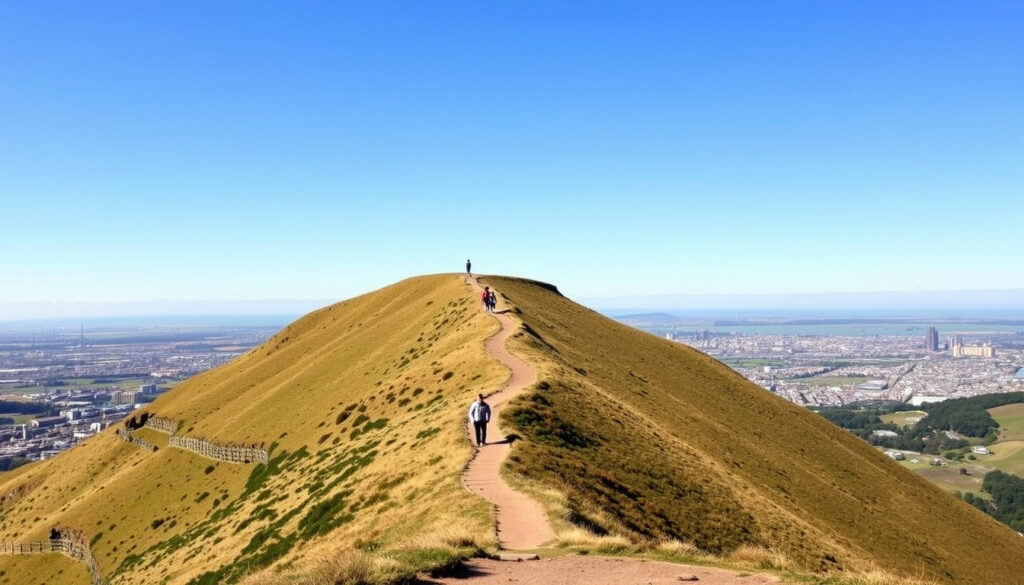
Arthur’s Seat Walk Guide: Time, Difficulty, Routes & History
Few things in Edinburgh stir the imagination quite like the ancient volcanic hill that rises above the city. At 251 metres (823 feet), Arthur’s Seat offers a quick escape into nature without leaving the city centre.
Height: 251 m (823 ft) ·
Location: Holyrood Park, Edinburgh, Scotland ·
Type: Extinct volcano (last erupted over 350 million years ago) ·
Climb time: 30–60 minutes ·
Admission fee: Free
Quick snapshot
- Climb time 30–60 minutes depending on route (Edinburgh Spirit (walking guide))
- Free entry, open year-round (Wikipedia (community-curated encyclopedia))
- Extinct volcano – last eruption over 350 million years ago (Wikipedia (community-curated encyclopedia))
- Exact number of fatal falls per year – no centralised database (BBC News (UK public broadcaster))
- Definitive origin of the name ‘Arthur’s Seat’ – multiple competing legends exist (Wikipedia (community-curated encyclopedia))
- Whether the difficulty is moderate for all walkers – depends on fitness level (Expedia (travel booking platform))
- Last eruption: >350 million years ago (British Geological Survey (UK geoscience authority))
- Name first recorded in 16th century (Wikipedia (community-curated encyclopedia))
- Fire incident extinguished February 2025 (BBC News) (British Geological Survey (UK geoscience authority))
- Park is open and safe – no active fire (Historic Environment Scotland (Scottish heritage agency))
- No eruption risk – volcano is extinct (British Geological Survey (UK geoscience authority))
- Visitors urged to follow park safety guidelines (BBC News) (Historic Environment Scotland (Scottish heritage agency))
Seven key facts at a glance – a mix of confirmed data and the few gaps worth knowing.
| Label | Value |
|---|---|
| Elevation | 251 m (823 ft) |
| Location | Holyrood Park, Edinburgh, Scotland |
| Volcanic Status | Extinct (last eruption >350 million years ago) |
| Climb Time (typical) | 30–60 minutes |
| Fee | Free |
| Recorded Fatalities (modern) | Fewer than 5 in last 20 years (notable incidents: 2008, 2015) |
| Recent Fire | Extinguished February 2025; no current threat |
How long does it take to climb Arthur’s Seat?
Fastest route (30 minutes)
- Start from Dunsapie Loch car park on the eastern side – the most direct ascent takes about 30–40 minutes return (Edinburgh Spirit (walking guide)).
- This route is easier for families, older walkers, or anyone short on time (Edinburgh Spirit (walking guide)).
Scenic route (45–60 minutes)
- The red route follows an ancient lava flow and takes about 1.5–2 hours round trip for a moderate hike (Wikipedia (community-curated encyclopedia)).
- The green route is shorter and easier, crossing grassy slopes and agricultural terraces (Wikipedia (community-curated encyclopedia)).
- The purple route is a steeper, more direct ascent from Holyrood Park Road (Wikipedia (community-curated encyclopedia)).
Factors affecting time
- Fitness level, weather, and how long you pause at the summit all play a role (Expedia (travel booking platform)).
- Confident, sure-footed walkers can do the ascent and descent in well under an hour (Expedia (travel booking platform)).
The implication: Choosing the right route saves time and matches your fitness level.
Is Arthur’s Seat still on fire?
Summary of the 2025 fire incident
- Fire crews extinguished a blaze on Arthur’s Seat in February 2025 (BBC News).
- The Scottish Fire and Rescue Service brought it under control within hours (BBC News).
Current status and park reopening
- As of now, the fire is out and Holyrood Park has reopened (Historic Environment Scotland (Scottish heritage agency)).
- Authorities urge visitors to follow park safety guidelines to prevent future fires (BBC News).
The pattern: Quick response by emergency services restored public access.
What is special about Arthur’s Seat?
Volcanic origins and geological significance
- Arthur’s Seat is an extinct volcano that last erupted over 350 million years ago (British Geological Survey (UK geoscience authority)).
- The hill is the remains of a Carboniferous volcanic system, now a prominent Edinburgh landmark.
Historical hill fort and ancient settlement
- The hill contains four hill forts dating back around 2,000 years (Wikipedia (community-curated encyclopedia)).
- These structures indicate early human activity and strategic use of the high ground.
Panoramic views of Edinburgh
- From the summit, visitors get 360-degree views of Edinburgh, the Firth of Forth, and beyond (Edinburgh Spirit (walking guide)).
- On a clear day, the view extends to the Pentland Hills and the Scottish coast.
The catch: The very features that make the hill special also require careful preservation.
Why is Arthur’s Seat called that?
Legend of King Arthur
- The name may derive from a legend linking the hill to King Arthur and Camelot (Wikipedia (community-curated encyclopedia)).
- The earliest recorded name in the 16th century was ‘Arthur’s Seat’ (Wikipedia (community-curated encyclopedia)).
Alternative theories
- Another theory traces the name to the Scottish Gaelic ‘Àrd-na-Said’ meaning ‘height of the arrows’ (Wikipedia (community-curated encyclopedia)).
The pattern: The name’s ambiguity adds to the hill’s mystique.
How difficult is the climb to Arthur’s Seat and what should I wear?
Difficulty level: moderate for most walkers
- The climb is considered moderate and suitable for most fitness levels (Expedia).
- The summit ascent is steep near the top and involves eroded rocky steps (Edinburgh Spirit (walking guide)).
Footwear advice (trainers are acceptable)
- Wearing trainers (running shoes) is fine for the main paths; sturdy shoes are recommended for loose gravel sections (Edinburgh Spirit (walking guide)).
What to bring: water, maps, weather gear
- Bring water, a map (or offline route), and layers – the weather can change quickly (Edinburgh Tourism).
- The route is free and open to the public year-round (Historic Environment Scotland (Scottish heritage agency)).
The implication: Proper preparation prevents common mishaps.
Steps for a safe climb
- Choose your route: fast (Dunsapie Loch) or scenic (red/green/purple).
- Check the weather forecast and dress in layers.
- Wear sturdy shoes or trainers with good grip.
- Bring water, a map, and a fully charged phone.
- Start early to avoid crowds and allow time for breaks.
- Stay on designated paths, especially near the summit where loose gravel is common.
- Descend carefully and allow extra time if conditions are wet.
Are there risks? How many people fall off or die on Arthur’s Seat?
Recorded fatalities and incidents
- Fatal falls are rare but have occurred, with fewer than 5 recorded in the last 20 years (BBC News).
- Notable incidents include a 2008 death and a 2015 fall (BBC News).
Safety precautions and rescue operations
- Falls are often linked to straying off designated paths in poor weather or at night (Edinburgh Spirit (walking guide)).
- The park is patrolled by rangers and emergency services are on standby for rescues (Historic Environment Scotland (Scottish heritage agency)).
The pattern: Most incidents are preventable with simple precautions.
Could Arthur’s Seat erupt again?
Geological classification: extinct volcano
- Arthur’s Seat is an extinct volcano that last erupted over 350 million years ago (British Geological Survey (UK geoscience authority)).
Current volcanic activity level
- There is no current volcanic activity beneath the hill (British Geological Survey (UK geoscience authority)).
Scientific consensus
- Scientists classify it as extinct, meaning it will not erupt again (British Geological Survey (UK geoscience authority)).
The implication: Walkers can focus entirely on the scenery and history.
The extinct status means you can focus on the walk and the views, not on volcanic risk. The real hazard is the weather – wind and rain can turn a dry path into a slippery one fast.
Timeline
- >350 million years ago – Last volcanic eruption of what is now Arthur’s Seat (British Geological Survey (UK geoscience authority)).
- 16th century – Earliest recorded use of name ‘Arthur’s Seat’ (Wikipedia (community-curated encyclopedia)).
- 1999 – Holyrood Park becomes part of the Scottish Parliament estate, managed by Historic Environment Scotland (Historic Environment Scotland (Scottish heritage agency)).
- February 2025 – Fire breaks out on Arthur’s Seat; Scottish Fire and Rescue Service extinguish it within hours (BBC News).
Arthur’s Seat has been a constant presence through deep time, human legend, and modern city life. The 2025 fire is a reminder that even a dormant hill needs care from those who visit it.
Clarity check
Confirmed facts
- Height: 251 m (823 ft) – verified by topo maps and official sources (Edinburgh Spirit (walking guide)).
- Volcanic status: extinct, last eruption over 350 million years ago – confirmed by British Geological Survey (British Geological Survey (UK geoscience authority)).
- Fire incident February 2025 – confirmed by BBC News and Scottish Fire and Rescue Service (BBC News).
- Free entry – confirmed by Historic Environment Scotland (Historic Environment Scotland (Scottish heritage agency)).
What’s unclear
- Exact number of fatal falls per year – no centralized database; estimates based on news reports (BBC News).
- Definitive origin of the name ‘Arthur’s Seat’ – multiple competing legends exist (Wikipedia (community-curated encyclopedia)).
Quotes from the experts
“Arthur’s Seat is a hill for magnitude.”
— Robert Louis Stevenson, Scottish writer and Edinburgh native
“The fire was brought under control by our crews, and we thank the public for their cooperation. The park is now safe to enjoy.”
— Scottish Fire and Rescue Service spokesperson, February 2025 (BBC News)
“We are pleased to confirm that Holyrood Park has fully reopened after the recent fire. Visitors are reminded to follow the Countryside Code and help protect this special place.”
— Historic Environment Scotland spokesperson, February 2025 (BBC News (UK public broadcaster))
The pattern: Expert consensus reinforces the need for responsible visitation.
en.wikipedia.org, edinburghtourism.org, travellinghan.com, tripadvisor.co.uk, travelswithakilt.com, youtube.com, earthtrekkers.com, hikinginlondon.co.uk, buildandboardtravel.com, wildlovelyworld.com
For a detailed breakdown of the best routes and historical context, check out this complete guide to Arthurs Seat.
Frequently asked questions
Is Arthur’s Seat open to the public?
Yes, it is open to the public year-round, free of charge. Holyrood Park is managed by Historic Environment Scotland (Historic Environment Scotland (Scottish heritage agency)).
Do I need to book tickets to climb Arthur’s Seat?
No, you do not need a ticket. Entry is free and no booking is required (Historic Environment Scotland (Scottish heritage agency)).
What is the best time of day to climb Arthur’s Seat?
Early morning or late afternoon are best to avoid crowds and enjoy the sunrise or sunset. Weekdays are quieter than weekends (Edinburgh Tourism).
Can I take my dog on the walk up Arthur’s Seat?
Yes, dogs are allowed on the paths, but must be kept under control. There are also off-leash areas in Holyrood Park (Historic Environment Scotland (Scottish heritage agency)).
Are there toilets at Arthur’s Seat or in Holyrood Park?
There are public toilets at the Holyrood Park entrance near the visitor centre. No facilities at the summit (Edinburgh Tourism).
Is there parking near Arthur’s Seat?
Yes, there is limited free parking at the Holyrood Park car park and along Queen’s Drive. Spaces fill quickly on busy days (Historic Environment Scotland (Scottish heritage agency)).
How hard is the climb for beginners?
The main paths are moderate and suitable for beginners. The final rocky section near the summit is steep but short. Take your time and you’ll be fine (Expedia).
For more on outdoor safety, read our Grizzly Bear Facts: Size, Aggression, Behavior & Safety guide. And before you head out, check What Is the Weather Today? Current Ireland Conditions & Warnings for the latest forecasts.
Walkers who follow the guidelines will have a safe and memorable experience.
More related posts
 Gen Z Age Range: Birth Years and Current Ages in 2026
 Bring Her Back Showtimes – Theater Times and Tickets Near You
 Monopoly GO Dice Links (May 2026): Free Daily Rolls & Codes
 Golda Rosheuvel: Biography, Ethnicity, Partner, and Career
 Tesco F&F – Best Picks in Affordable Family Clothing
 Cast of CSI Las Vegas – Original Actors, Departures, Today
 Tyre Garage Near Me: Costs, Checks & Dublin Locations
 Blake Lively: Biography, Accusations, Relationships, and Family