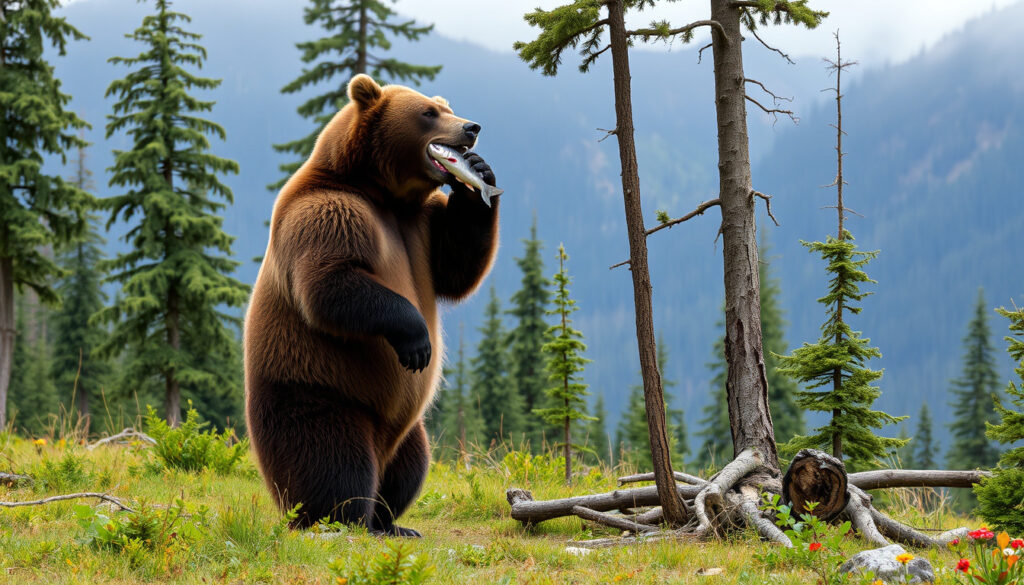
Grizzly Bear Facts: Size, Aggression, Behavior & Safety
There’s something about the word “grizzly” that makes you pause. It sounds heavy, old, and maybe a little dangerous—which is fair, because the bear behind the name has been surprising people for centuries. Here’s what science and wildlife agencies actually know about grizzly size, aggression, and behavior, so you can spot the difference between fact and folklore. By the end, you’ll have a clearer picture of North America’s most talked-about brown bear.
Scientific name: Ursus arctos horribilis ·
Average weight (male): 180–360 kg (400–790 lb) ·
Height on all fours: 1.0–1.5 m (3.3–4.9 ft) ·
Standing height: 1.8–2.4 m (5.9–7.9 ft) ·
Top speed: 48 km/h (30 mph) ·
Lifespan in wild: 20–25 years
Quick snapshot
- Males up to 360 kg (Get Bear Smart)
- Standing height to 2.4 m (Bear Aware – field comparison)
- Females roughly 30% smaller (Get Bear Smart)
- Omnivorous: roots, berries, fish, mammals (BearWise)
- Hibernate 5–7 months (Bear Aware) (BearWise)
- Solitary except mothers with cubs (Get Bear Smart)
- Western Canada, Alaska, northwestern US (Bear Aware – range overview)
- Montane forests, tundra, grasslands (Get Bear Smart)
- Once widespread across North America (U.S. National Park Service – Yellowstone wildlife guide)
- Listed as Threatened (US ESA) in lower 48 (U.S. Fish and Wildlife Service – species profile)
- Estimated 50,000 in North America total (U.S. Fish and Wildlife Service)
- Primary threats: habitat loss, human conflict (BearWise)
Eight key specs, one pattern: grizzlies are built for power, not speed—and their numbers tell a story of slow recovery.
| Specification | Value |
|---|---|
| Scientific name | Ursus arctos horribilis |
| Average weight (male) | 180–360 kg (400–790 lb) |
| Average weight (female) | 130–200 kg (290–440 lb) |
| Shoulder height | 1.0–1.5 m (3.3–4.9 ft) |
| Standing height | 1.8–2.4 m (5.9–7.9 ft) |
| Top speed | 48 km/h (30 mph) |
| Lifespan (wild) | 20–25 years |
| Population in lower 48 | ~1,500–2,000 (2023 est.) |
Why are bears called grizzly?
The name comes from the fur, not the mood. The long guard hairs on a grizzly’s back and shoulders are often silver-tipped, creating a grizzled or frosted appearance. The U.S. National Park Service (Yellowstone wildlife team) notes that “grizzly” entered English through the Lewis and Clark expedition, who described the bear they encountered as “grisly” (a variant spelling). Later naturalists settled on Ursus arctos horribilis—”horrible brown bear”—as the official scientific name, a nod to both its size and its reputation.
The etymology reveals more about human perception than bear behavior.
How tall is a fully grown grizzly bear?
Three measurements, one key takeaway: grizzlies are deceivingly large.
What is the average weight of a grizzly bear?
- Adult males: 180–360 kg (400–790 lb), with coastal bears in Alaska hitting the upper end (Get Bear Smart).
- Adult females: 130–200 kg (290–440 lb)—roughly 30% lighter (Get Bear Smart).
- Data from Bear Aware confirms males can exceed 450 kg in prime salmon habitat.
How big are grizzly bear teeth?
- Canines up to 6 cm long, designed for gripping and tearing.
- Crushing molars allow them to process roots, berries, and bone.
- Comparable in size to a large domestic dog’s jaw, but with far more muscle behind it.
What this means: A 2.4-meter grizzly on two legs isn’t just tall—it’s a mass of bone and muscle that can outrun a horse over short distances. Size alone doesn’t define danger, but it certainly sets the stage.
Who is more aggressive, a black bear or a grizzly bear?
This is the question that hikers, hunters, and campers ask most often. The answer, grounded in decades of incident data, is clear.
What is the most aggressive bear in the world?
- Polar bears are widely considered the most aggressive toward humans because they have evolved with little fear of people and actively hunt for food (BearWise).
- Grizzlies are defensive aggressors—they attack when surprised, when protecting cubs, or when a food source is threatened.
- Black bears are generally less aggressive but still responsible for more total attacks due to their larger population and wider range.
Which bear has killed the most humans?
- Black bears account for more fatal attacks overall, but grizzlies have a higher fatality rate per encounter.
- According to the NPS (Yellowstone bear incident records), most bear-related human injuries in the park are caused by grizzly bears, usually during surprise encounters with females and cubs.
The pattern: Grizzlies are more likely to escalate a confrontation, while black bears tend to flee. The data suggests that proximity to a mother grizzly is the single most dangerous scenario in North American bear country.
For anyone hiking in the Rockies or the northern forests, knowing which bear you’re facing changes your response. Grizzlies demand a different protocol—stand your ground, use bear spray—while black bears often respond to loud noise and slow retreat.
Here’s how grizzlies and black bears differ on key traits:
| Trait | Black Bear | Grizzly Bear |
|---|---|---|
| Size (male weight) | 150–600 lbs | 400–1,000 lbs |
| Aggression toward humans | Generally less aggressive; tends to flee | Defensive; escalates when protecting cubs or food |
| Claw shape | Short, curved (for climbing) | Long, straight (for digging) |
| Shoulder hump | None | Prominent muscle mass |
| Facial profile | Straight | Concave (dish-shaped) |
What is a grizzly bear’s worst enemy?
It’s not another predator you’d picture in a wildlife documentary. The answer is less dramatic but far more consequential.
- Humans: Habitat fragmentation, hunting, and vehicle collisions are the leading causes of grizzly mortality (U.S. Fish and Wildlife Service).
- Other grizzlies: Males sometimes kill cubs to bring females into heat, and food competition can turn deadly.
- Wolves and mountain lions: Occasionally take cubs, but rarely challenge an adult.
- Polar bears: Physically larger but their ranges barely overlap; a direct confrontation is exceptionally rare.
The catch: The most persistent threat to grizzly survival is us—yet the same species is also responsible for their partial recovery through legal protections and habitat conservation.
What smell does a bear hate?
Bears rely heavily on smell, so certain odors can deter them—or attract them.
What is the 3 bear rule?
- Food: Store all food in bear-resistant containers or hung at least 3 m above ground.
- Trash: Use bear-proof bins and never leave garbage overnight.
- Scented items: Deodorant, soap, toothpaste, and even sunscreen can attract bears; lock them away.
Strong smells like ammonia and bleach are known to irritate bears, but the most effective deterrent by far is BearWise.org (bear safety education platform)-recommended capsaicin spray, which causes temporary pain and disorientation.
The trade-off: Repellents work best when prevention fails. No smell—natural or chemical—replaces proper food storage and a clean camp.
For campers in grizzly country, the 3 bear rule is non-negotiable: control food, trash, and scented items, or risk drawing a bear that is far less willing to leave than you.
Could 100 men beat a grizzly bear in a fight?
This hypothetical has circulated online for years. The short answer, based on the bear’s biology and psychology, is almost certainly no.
Who would win, hippo or polar bear?
- Grizzly speed: 48 km/h—faster than any human can sprint, even in a group (Bear Aware).
- One swipe from an adult grizzly can break bones and disembowel a person.
- Human coordination under extreme stress: unlikely to hold; panic and miscommunication would dominate.
- Hippo vs polar bear: a hippo’s size (up to 1,500 kg), aggression, and aquatic adaptation give it a decisive advantage over even the largest land carnivore.
The pattern: Raw numbers—100 people vs. one bear—sound promising on paper, but the physical gap is too vast. A grizzly’s armament (claws, teeth, weight) and combat instinct outmatch any unarmed group’s ability to coordinate efficiently.
What we know vs. what’s still uncertain
Confirmed facts
- Grizzly is a subspecies of brown bear (Ursus arctos) (Get Bear Smart).
- Average weight ranges confirmed by multiple agency studies (NPS, Get Bear Smart).
- Grizzlies killed more humans per encounter than black bears in recent decades (U.S. National Park Service).
What’s unclear
- Exact number of grizzlies in lower 48 remains controversial due to counting methods.
- Whether polar bears or grizzlies are more aggressive toward humans is debated in the literature.
- Hippo vs polar bear outcome is speculative and not supported by observed behavior.
Expert perspectives
Grizzly bears are more likely to rely on their size and aggressiveness to protect themselves and their cubs.
U.S. National Park Service – Yellowstone bear guide
Black bears adapt more easily to human presence; grizzlies require larger undisturbed landscapes.
BearWise.org – bear safety education platform
The grizzly’s shoulder hump is a mass of muscle designed for digging—a trait that black bears lack entirely.
Get Bear Smart – field identification guide
Grizzlies are not the mindless killers folklore paints them as, but they are also not the cuddly giants some wildlife documentaries suggest. For anyone living, hiking, or working in their range, the choice is clear: respect their space, store food properly, and carry bear spray—or risk a confrontation that statistics say you’re likely to lose.
Related reading: Best Dog Advent Calendar 2025 UK: Top Picks & Reviews · Jurassic Park Movies in Order: Release & Chronological Guide
For a detailed account of a real-world encounter, read about a recent grizzly bear attack in Bella Coola that highlights the importance of bear spray and safety protocols.
Frequently asked questions
What do grizzly bears eat?
They are omnivores. Their diet varies by season: roots, berries, grasses, insects, fish (especially salmon), and occasionally small mammals or carrion. In fall, they enter hyperphagia, consuming up to 20,000 calories a day to build fat reserves for hibernation.
Where do grizzly bears live?
Grizzlies are found in western Canada, Alaska, and the northwestern United States (Montana, Wyoming, Idaho, and Washington). They inhabit montane forests, alpine tundra, and coastal regions. The lower-48 population is concentrated around Yellowstone and Glacier National Parks.
Are grizzly bears endangered?
In the contiguous United States, they are listed as Threatened under the Endangered Species Act (since 1975). The overall North American population is estimated at 50,000, with healthy numbers in Alaska and Canada. Recovery in the lower 48 has been slow but measurable.
How fast can a grizzly bear run?
Grizzlies can reach speeds of up to 48 km/h (30 mph) in short bursts. That’s faster than Usain Bolt’s top speed, so outrunning one on foot is impossible. The best defense is standing your ground and deploying bear spray.
Do grizzly bears hibernate?
Yes, they enter deep winter dens for 5–7 months, typically from November to March. During hibernation, body temperature drops slightly, heart rate slows, and they survive solely on stored fat. Females give birth during hibernation.
How can you identify a grizzly bear?
Look for a prominent shoulder hump, concave facial profile, and long (2–4 inch) claws adapted for digging. Black bears lack the hump, have a straighter profile, and shorter, curved claws for climbing. Fur color alone is misleading—both species can range from blonde to black.
What is the difference between a grizzly and a brown bear?
The grizzly is a subspecies of brown bear (Ursus arctos horribilis) native to North America. “Brown bear” generally refers to the Eurasian populations and coastal North American subspecies. Grizzlies tend to be smaller than coastal brown bears and live in interior habitats.
More related posts
 Adidas Adios Pro 3 Review: Is It Worth It? Specs & Comparisons
 Free PDF Editor Online: Edit Without Login or Watermark
 Al Nassr vs Al Shabab: H2H Stats and Match Prediction
 Foods High in Potassium – Top 20 Sources Ranked by mg
 Lucy Punch Movies and TV Shows: Full List & Career Guide
 Kelly Smith: England Legend’s Career and Private Life
 Canon EOS R6 Mark II Review: Is It Worth Buying in 2026?
 Louie Spence Now: Career, Net Worth and More