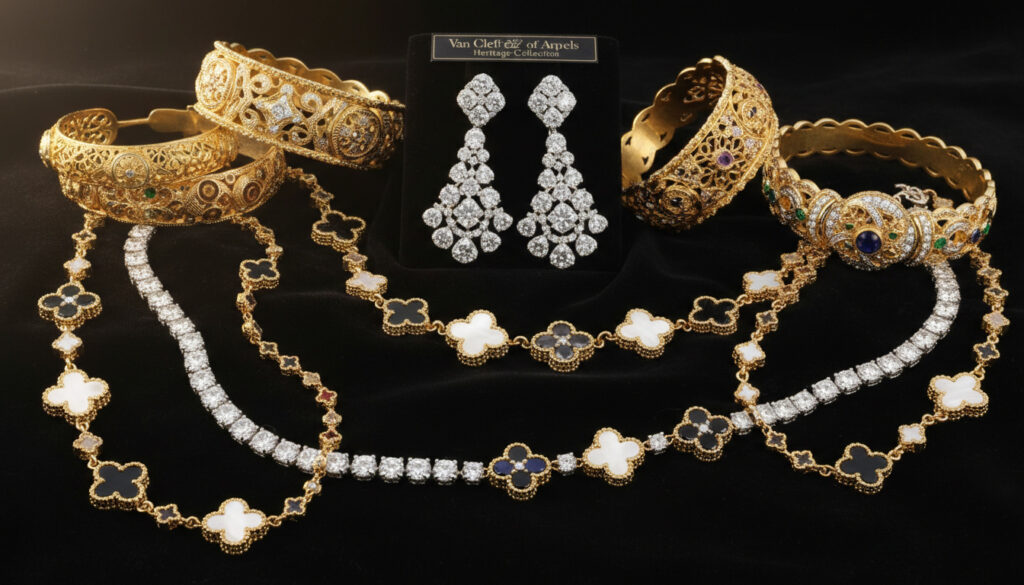
Van Cleef and Arpels – History Ownership Collections Guide
Van Cleef & Arpels stands as one of the most prestigious French luxury jewelry maisons, distinguished by its Alhambra motifs and invisible gemstone settings. Founded in 1906 at 22 Place Vendôme in Paris, the house has defined high jewelry through romantic, nature-inspired designs and technical innovations like the Mystery Set.
The maison attracts collectors and celebrities alike, offering pieces that span from accessible luxury to million-dollar high jewelry creations. Its standing in the luxury hierarchy rivals Cartier and Bulgari, yet maintains a distinct identity rooted in familial artistry and architectural elegance.
This guide examines the brand’s origins, its acquisition by Richemont, signature collections, and the practical considerations of authenticity and investment value.
What is Van Cleef & Arpels?
1906, Paris
France (Richemont-owned)
Alhambra motif, Mystery Set
High jewelry & watches
- Pioneer of invisible setting techniques patented in 1933
- Wholly owned subsidiary of Compagnie Financière Richemont SA
- Iconic four-leaf clover Alhambra collection launched 1968
- Favored by royalty and celebrities since the Belle Époque
- Resale values typically retain 60-80% of retail
- Family-operated until Richemont acquisition in 1999-2003
- Continuous operation at 22 Place Vendôme since founding
| Category | Details |
|---|---|
| Founders | Alfred Van Cleef & Estelle Arpels |
| Established | 1906 |
| Headquarters | Paris, France |
| Current Owner | Compagnie Financière Richemont SA |
| Signature Technique | Mystery Set (patented 1933) |
| Flagship Collection | Alhambra (launched 1968) |
| Global Presence | 100+ boutiques worldwide |
| Core Materials | 18k gold, high-grade gemstones |
Who Founded Van Cleef & Arpels and Its History?
The Marriage That Started a Dynasty
Alfred Van Cleef, son of a Dutch diamond cutter, married Estelle Arpels, daughter of gem dealer Salomon Arpels, in Paris in 1895. This union merged two families with deep technical expertise in precious stones and cutting, establishing the foundation for what would become a legendary jewelry house.
From Family Atelier to Place Vendôme
The initial atelier opened around 1896 with Salomon Arpels, transitioning to the iconic boutique at 22 Place Vendôme in 1906. Estelle’s brothers Charles, Julien (joining 1906-1908), and Louis (1912-1913) became partners, creating a true family enterprise positioned across from the Ritz Hotel.
The 22 Place Vendôme location, established in 1906, remains the flagship boutique today, positioned across from the Ritz Hotel and serving as the brand’s spiritual home.
Artistic Direction and Innovation
Their daughter Renée (Rachel) Puissant became Artistic Director in 1926, shaping the brand’s fairy-tale aesthetic. The family faced significant challenges during WWII, including forced “Aryanization” measures under occupation, before maintaining control until the 1990s when non-family executives gradually assumed leadership roles.
Who Owns Van Cleef & Arpels?
The maison remained family-controlled for nearly a century until the Swiss luxury conglomerate Richemont initiated acquisition in 1999, purchasing a 60% stake. This increased to 80% by 2001, with full ownership completed by 2003.
Van Cleef & Arpels operates as a wholly owned subsidiary of Compagnie Financière Richemont SA, the third-largest luxury group globally, alongside maisons including Cartier and Chloé.
Under Richemont stewardship, the brand has expanded its global boutique network while maintaining its Parisian manufacturing ateliers. The transition preserved the house’s artistic direction while introducing corporate governance structures typical of publicly traded luxury entities.
What Are the Most Famous Van Cleef & Arpels Collections?
The Alhambra Collection
Introduced in 1968, the Alhambra collection features the four-leaf clover motif inspired by Moorish architecture and symbols of luck. These pieces remain the brand’s most commercially successful, with entry-level earrings typically ranging $5,000-$10,000 and necklaces exceeding $15,000. Vintage Alhambra variations command premium prices at auction.
Mystery Set Technique
Patented in 1933, this invisible setting technique allows gemstones—particularly rubies and sapphires—to appear floating without visible prongs. Only the most skilled artisans can execute this complex engineering, requiring perfectly calibrated stones cut with microscopic grooves that slide onto gold rails.
Frivole and Nature Themes
Collections like Frivole and Vintage Frivole emphasize whimsical, nature-inspired designs featuring flowers and animals, contrasting with geometric-focused competitors. These designs reflect the maison’s historical emphasis on fairy-tale narratives and botanical forms.
Genuine pieces feature sharp “VCA” engravings, consistent gem clarity, and substantial weight due to 18k gold construction. Counterfeits often display lighter plating, blurry motifs, and irregular stone settings.
Is Van Cleef & Arpels Jewelry Worth It? Pricing and Authenticity
Investment Value and Resale
Resale values remain robust, with pieces typically retaining 60-80% of retail on secondary markets. Alhambra items particularly hold value due to consistent demand and limited production runs. High jewelry pieces exceeding $100,000 often appreciate at auction, especially those featuring the Mystery Set technique. How to Write a CV – Step-by-Step Guide with UK Examples provides guidance on documenting valuable assets for insurance purposes.
Authenticity Verification
Verify through serial numbers, hallmark stamps indicating gold purity, and certificates of authenticity. The Mystery Set technique serves as a signature engineering marker difficult to replicate, while genuine hardware maintains substantial weight incompatible with base-metal counterfeits.
Comparison with Cartier
While Cartier emphasizes bold geometry and panther motifs, Van Cleef & Arpels focuses on romantic, nature-driven narratives. Both utilize comparable 18k gold and gem quality, though VCA’s invisible settings offer distinct technical artistry that differentiates its engineering approach.
How Did Van Cleef & Arpels Evolve Through Time?
- 1895: Alfred Van Cleef marries Estelle Arpels in Paris, uniting two jewelry families
- 1896: Initial atelier opens with Salomon Arpels (Estelle’s father)
- 1906: Flagship boutique opens at 22 Place Vendôme across from the Ritz Hotel
- 1908: Julien Arpels joins as partner
- 1912: Louis Arpels becomes partner, completing the brother alliance
- 1926: Renée Puissant appointed Artistic Director, establishing the fairy-tale aesthetic
- 1933: Mystery Set technique patented
- 1941: Family faces forced “Aryanization” under WWII occupation
- 1968: Alhambra collection launched, becoming the iconic four-leaf clover design
- 1999-2003: Richemont acquisition from family ownership
What Facts Are Established Versus Uncertain?
Established Information
- Founded 1906 by Alfred Van Cleef and Estelle Arpels at 22 Place Vendôme
- Richemont acquired 60% in 1999, reaching full ownership by 2003
- Mystery Set technique patented in 1933
- Alhambra collection introduced in 1968
- 18k gold standard with “VCA” hallmarks
Uncertain or Disputed
- Specific production numbers for limited editions remain undisclosed
- Complete contemporary celebrity endorsement lists lack comprehensive documentation
- Exact vintage pricing fluctuations on secondary markets vary by condition
What Does Van Cleef & Arpels Represent in Luxury Culture?
The maison occupies a unique position emphasizing poetic, nature-inspired luxury rather than overt architectural statements. Its proximity to the Ritz Hotel since 1906 established immediate aristocratic credentials among Parisian high society.
The Alhambra motif transcends jewelry to become a cultural symbol of luck and elegance, recognized even by those outside traditional high jewelry circles. Unlike competitors focusing on masculine geometric power, VCA maintains a distinctly feminine, whimsical narrative rooted in botanical and ballet themes.
This positioning attracts collectors seeking pieces that function simultaneously as status symbols and artistic expressions, distinct from the more corporate aesthetic of conglomerate-owned rivals.
Expert Sources and Brand Archives
“The jewel must appear to be born of light.”
— Brand Philosophy, Van Cleef & Arpels Archives
“Alhambra represents timeless elegance through architectural geometry translated into wearable art.”
— Official Collection Documentation
Primary sources include official brand archives, Richemont annual shareholder reports, and verified auction records from Christie’s and Sotheby’s. Genealogical records confirm the 1895 marriage and subsequent business partnerships.
Key Takeaways
Van Cleef & Arpels represents 118 years of continuous luxury jewelry production, transitioning from a family partnership to a Richemont-owned global brand while maintaining technical innovations like the Mystery Set. Its Alhambra collection remains the definitive entry point for collectors, offering strong resale value and distinctive design DNA. Prospective buyers should verify authenticity through official dealers and documentation, particularly given high counterfeit prevalence. For regulatory comparisons across jurisdictions, see Can a Pharmacist Prescribe Antibiotics – Rules by Country and State.
Frequently Asked Questions
Who currently owns Van Cleef & Arpels?
Richemont acquired majority stakes beginning in 1999, reaching full ownership by 2003. The Swiss luxury conglomerate operates VCA as a wholly owned subsidiary.
Is Van Cleef & Arpels jewelry made from real gold?
Yes. Pieces typically utilize 18k yellow or white gold, marked with “VCA” hallmarks, serial numbers, and appropriate metal purity stamps.
How much does an Alhambra necklace cost?
Entry-level necklaces start around $15,000, while earrings range from $5,000 to $10,000. High jewelry pieces and rare vintage items command significantly higher prices.
Where is the original Van Cleef & Arpels boutique?
The flagship remains at 22 Place Vendôme in Paris, opened in 1906 and continuously operated since founding.
How can I authenticate a Van Cleef & Arpels piece?
Check for sharp engravings, substantial weight, consistent gem settings, and official certificates. The Mystery Set technique serves as a difficult-to-replicate marker.
Does Van Cleef & Arpels hold resale value?
Yes. Pieces typically retain 60-80% of retail value, with Alhambra items particularly sought after on secondary markets.
Who were the original founders?
Alfred Van Cleef, son of a diamond cutter, and Estelle Arpels, daughter of gem dealer Salomon Arpels, married in 1895 and established the house in 1906.
What is the Mystery Set technique?
Patented in 1933, this invisible setting allows gemstones to appear floating without visible prongs, requiring perfectly calibrated stones and master craftsmanship.
More related posts
 Damien Molony: Irish Actor, Brassic & Two Weeks in August
 Bob Geldof: Net Worth, Live Aid, Custody, and Life Today
 Golda Rosheuvel: Biography, Ethnicity, Partner, and Career
 What Is the Weather Today? Current Ireland Conditions & Warnings
 Michelle Fairley Movies and TV Shows – Full Filmography Guide
 King George VI: Biography, Facts, Cause of Death, and Legacy
 Tottenham vs AFC Bournemouth Lineups – Predicted XIs, Injuries, Team News
 Al Nassr vs Al Shabab: H2H Stats and Match Prediction