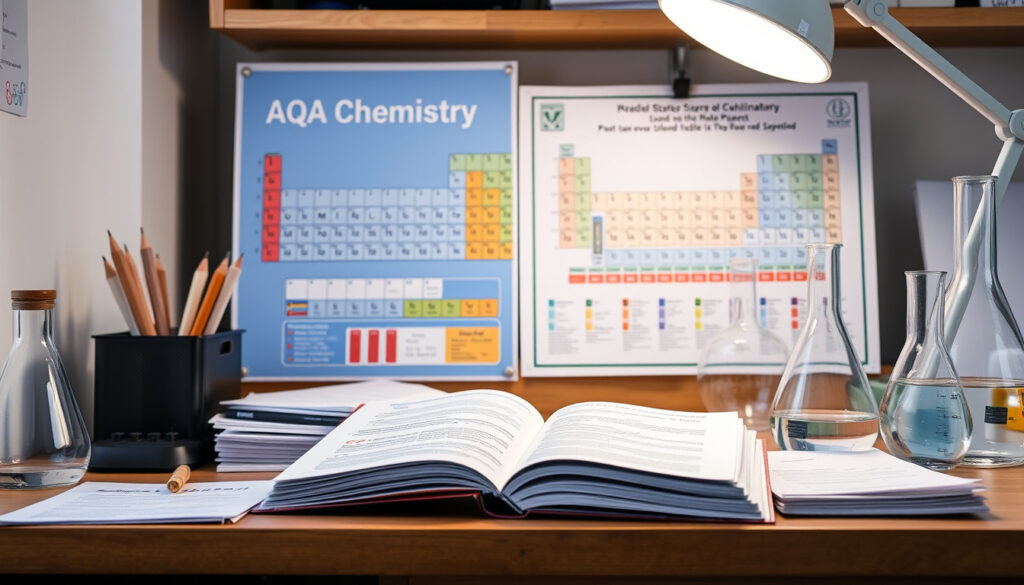
AQA A-Level Chemistry: Past Papers, Syllabus & Resources
Whether you’re revising for your first mocks or grinding through past papers the week before finals, AQA A-level Chemistry (specification 7405) can feel like a mountain to climb. The good news: the official syllabus, structured revision notes, and years of past papers are all publicly available — you just need to know where to look. This guide pulls everything together in one place.
Specification Code: 7405 · Exam Structure: Linear · First Teaching: 2015 · Official Site: aqa.org.uk · Revision Resource: physicsandmathstutor.com
Quick snapshot
- Spec code 7405 on AQA Official Specification
- Linear qualification from 2015 (AQA Official Specification)
- Three exam papers totalling 300 marks (AQA Official Specification)
- Post-2024 past paper availability
- Exact grade boundary thresholds for 2023–2024 series
- AQA-approved textbook list not publicly listed on AQA site
- Spec published 2015 (Studocu confirmation)
- First AS exams (7404): May/June 2016 (Studocu confirmation)
- First A-level exams (7405): May/June 2017 (Studocu confirmation)
- Practicals endorsement (pass/fail, 12 required experiments)
- Paper 3 synoptic focus with 30 multiple-choice questions
- Mathematical skills weighted across all three papers
| Label | Value |
|---|---|
| Specification | Chemistry 7405 |
| Board | AQA |
| Format | Linear A-level |
| Launch Year | 2015 |
| Key Resource | physicsandmathstutor.com |
AQA A Level Chemistry past papers
Past papers are the single most effective revision tool for 7405, and they are freely available from multiple archives. The exam board itself offers sample papers and the Exampro question bank through aqa.org.uk, while third-party platforms like Physics and Maths Tutor (past paper archive with model answers) and Revision Science (past paper listings through June 2024) host complete series going back to 2017. Papers for June 2022 and June 2024 are available for both Paper 1 and Paper 2, complete with data sheet inserts and mark schemes.
Mark schemes
Every official paper released by AQA comes paired with a mark scheme that shows exactly how marks are awarded for each question type. Physics and Maths Tutor (past paper archive) provides annotated mark schemes alongside some papers, making it easier to understand the examiner’s expectations without having to decode a raw PDF.
Topic-wise papers
Some platforms sort past paper questions by topic rather than by exam series. Exam Papers Practice (topic-sorted revision notes) aggregates questions from past papers against specific syllabus points, so you can target weak areas without wasting time on topics you’ve already mastered.
Exam series archives
The full archive of AQA 7405 papers runs from May/June 2017 through to the most recent series. PastPapers.co (AQA chemistry 7405 archive) hosts papers, mark schemes and examiner reports in one searchable index. For older series (pre-2017), you may need to cross-reference with PapaCambridge’s directory, which also includes notes on specification changes.
AQA A Level Chemistry syllabus
The AQA A-level Chemistry syllabus (specification 7405) is divided into three mandatory sections: Physical Chemistry (3.1), Inorganic Chemistry (3.2), and Organic Chemistry (3.3). AQA Official Specification (exam structure overview) confirms the linear structure means all three papers are taken at the end of the two-year course, with no early module retakes allowed.
Specification at a glance
Paper 1 covers Physical Chemistry sections 3.1.1 to 3.1.4, 3.1.6 to 3.1.8, and 3.1.10 to 3.1.12, alongside the entire Inorganic Chemistry section (3.2). Paper 2 assesses Physical Chemistry sections 3.1.2 to 3.1.6 and 3.1.9, combined with the full Organic Chemistry section (3.3). AQA Official Specification (paper-by-paper topic mapping) lists the exact subsection codes so you can cross-reference with your textbook or revision notes.
Topic breakdown
Physical Chemistry topics include atomic structure, amount of substance, bonding, energetics, kinetics, equilibria, oxidation and reduction, thermodynamics, rate equations, Kp, electrode potentials, and acids and bases. Inorganic Chemistry covers periodicity, Group 2, Group 7, Period 3 elements and oxides, transition metals, and reactions of ions in aqueous solution. AQA Physical Chemistry Content (full topic list) details each subtopic with prescribed practicals embedded throughout.
Assessment objectives
Papers 1 and 2 are each 2 hours long, worth 105 marks, and account for 35% of the overall A-level grade. Paper 3 is 2 hours, 90 marks, and worth 30%, with a mix of practical technique questions (40 marks), a synoptic long-answer section (20 marks), and 30 multiple-choice questions. Save My Exams (paper structure and weighting breakdown) confirms the weighting split and adds context on how the practical endorsement is assessed separately.
The implication: each paper has a defined content boundary, so there’s no excuse for spending revision time on a topic that only appears in Paper 1 when you’re preparing for Paper 2.
AQA A Level Chemistry textbook
No single textbook is officially mandated by AQA, but the exam board publishes a list of approved resources on aqa.org.uk that align with specification 7405. Save My Exams (approved textbook guidance) notes that AQA-approved textbooks undergo a review process to ensure coverage matches the syllabus point-for-point.
Recommended books
The most widely recommended options among students and teachers include the Chemistry in Focus series and standard AS/A-level texts published by major educational publishers. Exam Papers Practice (textbook alignment notes) maintains a curated list of books that map directly to 7405 section numbers, so you can verify coverage before purchasing.
CGP and Oxford options
CGP’s revision guides are popular for their concise summaries and practice questions, while Oxford University Press titles offer deeper conceptual explanations suited to students targeting A* grades. Scribd Cheat Sheets (summary sheets for Paper 1 topics) can supplement either option by providing a rapid-reference overview of key equations, definitions, and marking criteria for Physical and Inorganic Chemistry.
Digital vs print
Digital platforms like Save My Exams (interactive topic guides) offer video explanations, interactive quizzes, and dynamic progress tracking that print books cannot match. However, print remains preferred by many students for active reading and annotation. AQA Official Specification (resource listing) lists official teaching resources including schemes of work alongside the textbook list.
For students on a budget, one AQA-approved textbook plus Physics and Maths Tutor past papers and mark schemes gives you everything you need for under £40 — no subscription required.
AQA A Level Chemistry grade boundaries
Grade boundaries for AQA 7405 are published by the exam board after each exam series, and they vary from year to year depending on how the cohort performed. AQA (grade boundary data and statistics) releases the raw mark thresholds for grades A* through E alongside examiner reports shortly after results day.
Recent years
Because the linear specification was first examined in 2017, the full grade boundary history now spans eight series. Save My Exams (grade boundary analysis) provides trend summaries showing whether the threshold for a specific grade has risen or fallen over time, which is useful for setting realistic target scores before your actual exams.
A* to E scales
The A* boundary typically requires a mark in the high 80s percentage range across all three papers combined, while an E pass is generally set around 30–35% depending on the paper difficulty in any given year. Revision Science (past paper grade data) allows you to compare your practice paper scores against the published grade boundaries from that specific series.
Paper-specific
Grade boundaries are set per paper as well as for the overall qualification. PastPapers.co (paper-specific mark schemes and reports) archives the individual paper boundaries alongside each mark scheme, so you can use a single past paper to estimate your expected grade without waiting for an overall qualification total.
The pattern: grade boundaries tighten when papers are perceived as easier by the cohort, so treating last year’s boundaries as fixed targets for your upcoming exams is a mistake — always work backwards from the syllabus content mastery level, not the grade threshold.
AQA A Level chemistry notes
High-quality revision notes aligned to specification 7405 are freely available from several dedicated chemistry revision platforms, making it unnecessary to purchase expensive note-taking resources. Physics and Maths Tutor (AQA-specific revision notes archive) is the most widely used among students, offering topic-by-topic summaries written to match the current syllabus.
Summary notes
The most effective summary notes are those that map directly to each syllabus subsection. Save My Exams (topic summaries with worked examples) structures its notes by exam topic, including common pitfalls and examiner tips that go beyond what a textbook typically provides.
Topic worksheets
Topic-specific worksheets that combine a concise note summary with practice questions drawn from past papers are available on Exam Papers Practice (integrated note and question packs). These are particularly useful for identifying gaps after completing a past paper — rather than re-reading entire textbook chapters, you can target the exact subtopic where you lost marks.
Past questions integrated
Some revision platforms embed past paper questions directly into their note pages, tagged by syllabus code. Scribd Cheat Sheets (condensed formula and definition sheets) offer a rapid recall format for the final revision push, distilling Physical Chemistry formulas, organic reaction mechanisms, and inorganic trend summaries onto a small number of pages.
The AQA specification itself is a revision resource. Published in 2015 as Aqa-7404-7405-sp-2015.pdf, it lists every required subtopic, required practical, and mathematical skill. Many students overlook it, but it is the authoritative reference that all approved textbooks must align with.
“We involved over a thousand teachers in developing this specification, to ensure that the subject content is relevant to real world experiences and is interesting to teach and learn.”
“The study of kinetics enables chemists to determine how a change in conditions affects the speed of a chemical reaction.”
Related reading: Foods high in potassium · Amoxicillin 500mg dosage for adults
Students tackling AQA A-Level Chemistry 7405 often pair official materials with this syllabus and past papers guide for targeted exam practice and syllabus insights.
Frequently asked questions
What is AQA A-level Chemistry specification 7405?
Specification 7405 is the official AQA course code for linear A-level Chemistry, first taught from September 2015 and first examined in May/June 2017. It covers Physical, Inorganic, and Organic Chemistry across three exam papers plus a practical endorsement. AQA Official Specification (overview) holds the full topic list.
How many papers are in AQA A-level Chemistry?
There are three papers. Paper 1 and Paper 2 are each 2 hours, 105 marks, and worth 35% of the grade. Paper 3 is 2 hours, 90 marks, and worth 30%. All three include questions that assess practical skills. AQA Official Specification (paper structure) confirms the exact details.
Where to download the AQA A-level Chemistry data sheet?
The data sheet is available as an insert within the official past paper PDFs. Revision Science (past paper downloads with inserts) provides data sheet versions alongside June 2022 and June 2024 Paper 1 papers. The AQA website also hosts a standalone data sheet through its resources section.
What topics are in AQA A-level Chemistry Paper 1?
Paper 1 covers Physical Chemistry sections 3.1.1 to 3.1.4, 3.1.6 to 3.1.8, and 3.1.10 to 3.1.12, plus the entire Inorganic Chemistry section (3.2). It includes short-answer and long-answer questions testing content knowledge and practical skills. AQA Official Specification (topic mapping) lists the exact subsection codes.
How to use past papers for AQA A-level Chemistry?
Start with the most recent series available to gauge current question styles, then work backwards through older papers. Attempt each paper under timed conditions, mark it strictly using the official mark scheme, and log every mistake against the relevant syllabus code. Physics and Maths Tutor (marked past papers with model answers) adds video walkthroughs for Paper 1 questions to help you understand exactly where marks were awarded or lost.
What grade boundaries for AQA A-level Chemistry 2023?
Grade boundaries vary per paper and per series. AQA (official statistics and grade boundary data) publishes the exact thresholds after each exam series. As a general reference, an A* typically requires around 85–90% of the maximum total marks, though the exact figure shifts depending on overall cohort performance each year.
Are AQA A-level Chemistry notes free online?
Yes. Physics and Maths Tutor, Save My Exams, and Exam Papers Practice all offer free AQA-specific notes. AQA Official Specification itself is a free PDF download.
For students preparing for AQA A-level Chemistry, the path to a strong grade is straightforward: master the syllabus using official AQA documentation, build depth with an approved textbook, and sharpen exam technique with timed past paper practice. The resources exist; what counts now is how you use them.
More related posts
 Skin Cancer Pictures Early Stages: What to Look For
 Punjab Kings vs Royal Challengers Bengaluru Match Scorecard IPL 2025
 Olivia Attwood Love Island: Season, Split, and ADHD Diagnosis
 AS Monaco vs Man City Lineups: Confirmed Starting XI and Recap
 72 kg in Stone and Pounds: NHS Charts and Converter
 Al Nassr vs Al Shabab: H2H Stats and Match Prediction
 Michelle Fairley Movies and TV Shows – Full Filmography Guide
 When Is the Next Full Moon? 2026 Calendar & Dates