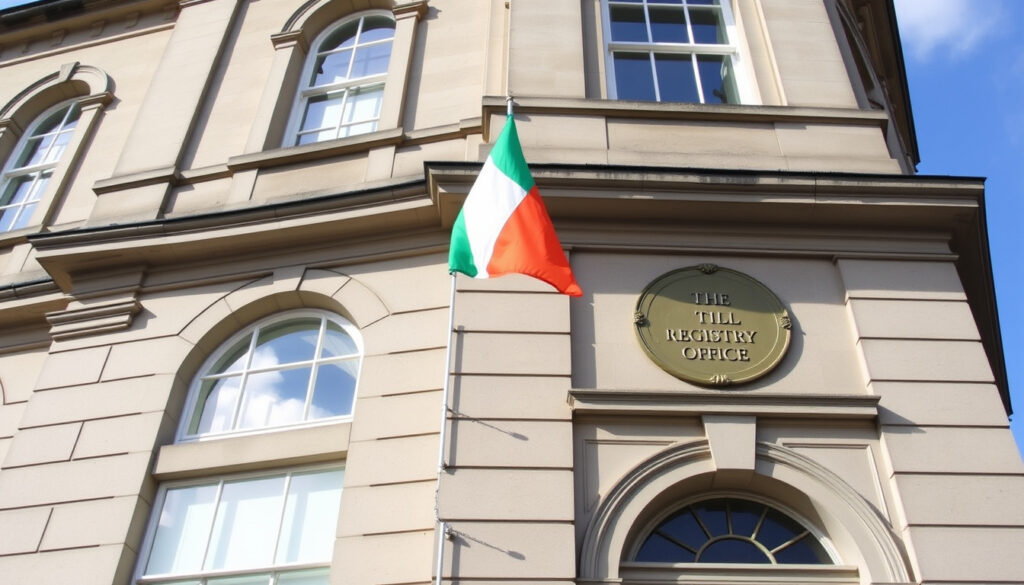
Registry Office: Meaning, Weddings & Records in Ireland & UK
Most people walk past their local registry office without giving it a second thought — until they need to register a birth, get married, or track down a family record. That single building does double duty as both a civil ceremony venue and the administrative hub for births, deaths, and marriages. This guide untangles the two roles, spells out the real costs and timelines, and walks you through exactly what to expect in Ireland and the UK.
Number of civil registration offices in Ireland: 30+ ·
Cost of a registry office wedding in Ireland: €200 (fee only, excludes venue extras) ·
Notice period required for marriage in Ireland: 3 months ·
Average duration of a registry office ceremony: 15–20 minutes ·
Marriage records in Ireland date back to: 1845
Quick snapshot
- Government office for recording births, deaths, and marriages (gov.ie – General Register Office)
- Venue for civil wedding ceremonies (gov.ie – Get married in Ireland)
- Issues official certificates (gov.ie – Get married in Ireland)
- Submit marriage notification 3 months before (Citizens Information – Registration of marriage)
- Pay €200 notification fee (gov.ie – Get married in Ireland)
- Ceremony lasts 15–20 minutes (Citizens Information – Registration of marriage)
- Give notice 28 days in advance (GOV.UK – Marriages and civil partnerships)
- Fees: notice £35 each + ceremony £46–£86 (GOV.UK – Marriages and civil partnerships)
- Ceremony lasts about 15–20 minutes (GOV.UK – Marriages and civil partnerships)
- Ireland: GRO online index covers 1845–present (Irish Genealogy – Civil records help)
- UK: General Register Office online service (Irish Genealogy – Civil records help)
- Records restricted for recent years (<75 years old) (Irish Genealogy – Civil records help)
Six key facts, one pattern: the notice period is the single biggest time constraint, and the costs are far lower than most traditional weddings — but the differences between Ireland and England/Wales matter more than most people expect.
Before we get into the details, here are the core numbers at a glance.
| Label | Value |
|---|---|
| Registry office official name in Ireland | Civil Registration Service |
| Registry office official name in England/Wales | Register Office |
| Minimum notice period (Ireland) | 3 months |
| Minimum notice period (England/Wales) | 28 days |
| Standard civil ceremony cost (Ireland) | €200 |
| Standard civil ceremony cost (England/Wales) | £46–£86 (plus £35 per person notice fee) |
What Does ‘Registry Office’ Mean?
If you ask someone in Dublin what a “registry office” is, they will probably point you to the Civil Registration Service — the government body that records every birth, death, and marriage in the Republic of Ireland (gov.ie – Ireland’s General Register Office). Ask someone in Liverpool the same question, and they will likely mention the Register Office, which does exactly the same job under a slightly different name (GOV.UK – Marriages and civil partnerships). The two terms are often used interchangeably, but there is a technical difference worth knowing.
Registry office vs. register office: same or different?
The official term in England and Wales is register office (with “-er”). Registry office is the common variant that has stuck in everyday speech. In Ireland, the service is called the Civil Registration Service, though most people still say “registry office.” The function is identical across both jurisdictions: they are government facilities where vital events are officially recorded and where civil wedding ceremonies take place.
- In Ireland, the service is run by the Health Service Executive (HSE) and the General Register Office (GRO) (gov.ie – General Register Office).
- In England and Wales, the General Register Office oversees all local register offices (GOV.UK – Marriages and civil partnerships).
Primary functions: civil registration and ceremonies
Every registry office handles two distinct types of work. First, it is the official record-keeper: when a baby is born, someone dies, or a couple marries, the registry office is where that event gets legally registered. Second, it is a ceremony venue — the place where couples can hold a simple, legally binding civil wedding without any religious element.
Most people visit a registry office for one of two reasons: they are planning a wedding or they need a certificate. The same building serves both purposes, which is why the staff handle everything from filing a death notice to officiating a ceremony — sometimes in the same day.
Why Would You Go to a Registry Office?
There are four main reasons someone steps through those doors. Each involves a specific procedure, timeline, and often a fee.
To register a birth, death, or marriage
Registering a birth or death is a legal requirement within a set timeframe. In Ireland, births must be registered within 3 months (Citizens Information – Registering a birth). Deaths must be registered within 3 months as well. Marriages are registered automatically by the registrar who conducts the ceremony — you do not need to make a separate trip for that.
To give notice of marriage or civil partnership
Before you can get married, you must give formal notice of your intention to marry. This is not a quick formality: you and your partner must attend the registry office in person, present documents (passport, proof of address, and any divorce or death certificates if previously married), and pay the notification fee.
- Ireland: Notice must be given at least 3 months before the wedding (Citizens Information – Registration of marriage).
- England and Wales: Notice must be given at least 28 days before the wedding (GOV.UK – Marriages and civil partnerships).
To hold a civil wedding ceremony
The ceremony itself is simple, secular, and short. A registrar reads the legal vows, you and your partner exchange rings if you choose, and the marriage is recorded. You need at least two witnesses. The ceremony can take place in the registry office itself or at an approved venue such as a hotel, castle, or garden (gov.ie – Get married in Ireland).
To request copies of certificates
Need a copy of your marriage certificate for a visa application or a pension claim? Registry offices handle certificate requests. In Ireland, a full standard marriage certificate costs €20 (gov.ie – Get married in Ireland). An uncertified copy of a register entry — suitable for research but not legal purposes — costs €5 (Citizens Information – Registration of marriage). Orders can be made online, by post, or over the counter at civil registration services (HSE – Order an Irish marriage certificate).
How Long Does a Registry Office Wedding Take?
The ceremony itself is famously short, but the overall timeline from giving notice to receiving your certificate stretches much longer. Here is the breakdown.
Typical ceremony duration
From the moment the registrar welcomes your guests to the moment you sign the register, expect about 15 to 20 minutes (GOV.UK – Marriages and civil partnerships). That includes the legal vows, ring exchange if applicable, and the signing of the marriage register. No hymns, no readings, no extended speeches — the ceremony is designed to be legally sufficient and nothing more.
Additional time for paperwork and notice
- Notice appointment: The appointment where you give notice of marriage takes about 30 minutes. You and your partner attend together, present documents, and pay the fee.
- Waiting period after notice: In Ireland, you must wait 3 months from the notice date before the wedding can happen (Citizens Information – Registration of marriage). In England and Wales, it is 28 days (GOV.UK – Marriages and civil partnerships).
- Arrival and photography: Most couples allow an extra 30–45 minutes on the day for arrival, pre-ceremony nerves, and a few photos outside the registry office.
The catch: the 15–20 minute ceremony is the easy part. The real time commitment is the 3-month or 28-day notice period, which cannot be shortened except in extremely rare circumstances — and even then, no standard exception exists in either jurisdiction.
Couples who walk in expecting a “quick wedding” are often caught out. The ceremony is fast, but the legal waiting period means you cannot marry within two weeks — or even within a month in Ireland. Plan the notice appointment first, then count forward.
How Much Does It Cost to Get Married in a Registry Office in Ireland?
Irish couples have a clear pricing structure, set by the government and published on official channels. Here is exactly what you will pay.
Standard civil ceremony fee
- Notification fee (non-refundable): €200 (gov.ie – Get married in Ireland).
- Marriage registration: Free. The registrar registers your marriage as part of the ceremony (gov.ie – Get married in Ireland).
- Certificate: A full standard Irish marriage certificate costs €20 (HSE – Order an Irish marriage certificate). An uncertified copy costs €5 (Citizens Information – Registration of marriage).
- Postage and packaging: €3.00 within Ireland, €5.00 to Great Britain, Europe, and the rest of the world (HSE – Order an Irish marriage certificate).
Additional costs for venue extras or certificates
- If you choose a larger room at the registry office, or a weekend slot, extra fees apply — these vary by location.
- The Multilingual Standard Form, useful if one of you is from another EU country, is free (Citizens Information – Registration of marriage).
- A certificate authenticated by the General Register Office (for international use) costs €10 (gov.ie – Get married in Ireland).
- Error correction on a marriage certificate is free (Citizens Information – Registration of marriage).
For comparison, in England and Wales, the notice fee is £35 per person and the ceremony fee ranges from £46 to £86 depending on the venue and day of the week (GOV.UK – Marriages and civil partnerships).
Can You Get Married Within 2 Weeks?
The short answer is no — not in Ireland, not in England or Wales, not by any standard route. The legal notice period makes it impossible.
Notice period requirements in Ireland and UK
- Republic of Ireland: Minimum 3 months’ notice (Citizens Information – Registration of marriage).
- England and Wales: Minimum 28 days’ notice (GOV.UK – Marriages and civil partnerships).
- Scotland: Minimum 28 days’ notice (via the National Records of Scotland).
- Northern Ireland: Minimum 28 days’ notice.
Exceptions and urgent circumstances
There are no standard exceptions that allow a shorter notice period. The notice requirement is a legal safeguard to prevent forced marriages and bigamy. Even if you have a medical emergency or are in the armed forces about to be deployed, you still need to go through the process — though some countries have a special “pensioner” or “terminal illness” fast-track, neither Ireland nor the UK does.
The trade-off: if you want a quick wedding, a registry office cannot deliver. But what it does deliver — low cost, legal simplicity, and zero religious requirements — makes it the right choice for couples who plan ahead.
Can You Look Up Marriage Records in Ireland?
Yes — Irish marriage records are public records, but recent ones have restrictions. Here is how to search.
Online search options
- The General Register Office (GRO) provides a free online index covering marriages from 1845 to present (Irish Genealogy – Civil records help).
- For records older than 75 years, full digital images are available to anyone. For records less than 75 years old, you need to show proof of relationship (you are the person named, or a direct descendant).
- The Irish Genealogy website (run by the Department of Tourism, Culture, Arts, Gaeltacht, Sport and Media) hosts the search tool (Irish Genealogy – Civil records search).
In-person requests at the General Register Office
- The GRO research office in Dublin is at 1 Werburgh Street, Dublin 2 (Irish Genealogy – Civil records help).
- The main GRO office is at Government Offices, Convent Road, Co Roscommon (gov.ie – General Register Office).
- Opening hours: Monday to Friday, 10am–1pm and 2pm–4pm (gov.ie – General Register Office).
- You can also request a search by post, though turnaround times vary depending on the volume of requests.
The pattern: online searches are free and fast for older records, but accessing recent marriage records requires a paper trail of your own identity and relationship. For genealogists, the 1845 start date is a goldmine — for someone checking if their ex has remarried, it is a dead end unless the marriage is more than 75 years old.
You cannot casually search for a living person’s marriage record in Ireland. The 75-year restriction is a serious privacy safeguard. If you need a recent marriage certificate for legal reasons (divorce, inheritance, immigration), you must prove you are directly affected.
How Far Back Do Irish Marriage Records Go?
Civil registration start date
Civil marriage records in Ireland begin in 1845 — that is the year the government first required all marriages (except those of Quakers and Jews) to be registered with the state (Irish Genealogy – Civil records help). Births and deaths were added later, in 1864.
Church records before 1845
Before civil registration, churches kept the only marriage records. Roman Catholic parish registers survive from the 1820s in many areas, but they are not part of the GRO’s collection. These records are held by individual parishes, local archives, and the National Library of Ireland. The National Library of Ireland has microfilmed Catholic parish registers for most dioceses (National Library of Ireland – Parish registers).
Why this matters: if you are researching ancestry before the mid-19th century, you will hit the “civil registration wall” at 1845. Beyond that, you must switch from government databases to church records and local archives — a different search skill entirely.
“Records dating from 1845 of marriages registered in Ireland.”
General Register Office (Ireland), official statement on marriage records coverage (Irish Genealogy – Civil records help)
“You must give three months’ notice of your intention to marry.”
Irish Civil Registration Service (HSE website), official guidance on notice period (Citizens Information – Registration of marriage)
“You must give notice at least 28 days before your wedding.”
UK Government guidance (GOV.UK), official notice period for England and Wales (GOV.UK – Marriages and civil partnerships)
“A full standard Irish marriage certificate costs €20.”
HSE, official price for marriage certificate ordering (HSE – Order an Irish marriage certificate)
Timeline: Civil Registration in Ireland and the UK
- 1837 — Civil registration begins in England and Wales.
- 1845 — Civil registration of marriages begins in Ireland (Irish Genealogy – Civil records help).
- 1864 — Civil registration of births and deaths begins in Ireland.
- 1922 — Partition of Ireland; separate GROs established for Northern Ireland and the Republic of Ireland.
- 2000s — Online appointment booking and certificate ordering introduced in both jurisdictions (gov.ie – Get married in Ireland).
Confirmed Facts vs. What’s Unclear
Confirmed facts
- Registry offices in England/Wales are officially called register offices (GOV.UK – Marriages and civil partnerships).
- Marriages require a minimum notice period: 28 days (England/Wales), 3 months (Ireland) (Citizens Information – Registration of marriage).
- Civil ceremony at a registry office lasts approximately 15–20 minutes.
- Marriage records in Ireland are available from 1845 onward through the GRO (Irish Genealogy – Civil records help).
- The notification fee for a civil marriage in Ireland is €200 (gov.ie – Get married in Ireland).
- A full Irish marriage certificate costs €20 (HSE – Order an Irish marriage certificate).
What’s unclear
- Exact wait times for certificate delivery vary by location and method.
- Whether some registry offices offer weekend ceremonies depends on local availability.
expat.com, irelandxo.com, gov.ie, irishancestors.ie, kilmorediocese.ie, reddit.com, weddingsinireland.ie
For a comprehensive overview of local services, you can refer to this UK register office guide which details how to find your nearest register office.
Frequently Asked Questions
What documents do I need to give notice of marriage?
You typically need a valid passport or national ID card, proof of address (utility bill or bank statement dated within the last 3 months), and if previously married, your original divorce decree or your former spouse’s death certificate. Requirements vary slightly between Ireland and England/Wales — check with the local registry office before your appointment (Citizens Information – Registration of marriage).
Can I get married at a registry office if I live abroad?
Yes, but you must meet the residency requirements. In Ireland, if neither of you lives in Ireland, you generally cannot marry there — at least one partner must have been resident in Ireland for at least 15 days before giving notice. In England and Wales, you must have lived in the registration district for at least 7 days before giving notice (GOV.UK – Marriages and civil partnerships).
Do I need witnesses for a registry office wedding?
Yes. You need at least two witnesses who are over 18 and capable of understanding the ceremony. They do not need to be related to you. The registrar will require them to sign the marriage register (GOV.UK – Marriages and civil partnerships).
Can I change the date after giving notice?
Yes, but it is not automatic. You must contact the registry office where you gave notice. If you change the date to one that falls outside the original notice period, you may need to give notice again — and pay the fee again. Always confirm directly with the office (Citizens Information – Registration of marriage).
Is a registry office wedding legally binding?
Yes. A civil ceremony conducted by a registrar at a registry office (or an approved venue) is fully legally binding in Ireland and the UK. It carries the same legal status as a church wedding. You will receive a marriage certificate that is accepted for all legal purposes (gov.ie – Get married in Ireland).
Can I bring my own music or readings to a civil ceremony?
Most registry offices allow background music (often a recording) but prohibit religious hymns or readings. The ceremony must remain secular by law. Some offices allow a short reading of a non-religious poem or text, but check with your specific office — rules vary (GOV.UK – Marriages and civil partnerships).
What is the difference between a civil ceremony and a religious ceremony at a registry office?
Registry offices do not host religious ceremonies. A civil ceremony is secular — no hymns, prayers, or religious references. If you want a religious ceremony, you must arrange that separately with a church or other religious body. Some registry offices can host a ceremony with cultural or spiritual elements as long as they are not religious (Citizens Information – Registration of marriage).
A registry office is two things at once — a civil ceremony venue and a government records office. For couples in Ireland, the key numbers are €200 for the notification fee and 3 months’ notice. For those in England and Wales, the notice period shrinks to 28 days, with fees starting around £46. The marriage records side of the house offers free online searching back to 1845, with a 75-year privacy wall on recent entries. Anyone planning a wedding in Ireland should start the notice process at least three months out, budget for the €200 fee and €20 certificate, and treat the registry office as the efficient, no-frills option it is — or look elsewhere if you want a longer ceremony.
More related posts
 Tesco F&F – Best Picks in Affordable Family Clothing
 Blake Lively: Biography, Accusations, Relationships, and Family
 Best Paddling Pool with Slide: Smyths Ireland Guide
 What Is the Weather Today? Current Ireland Conditions & Warnings
 Oasis Bonehead: Nickname, Reunion, and Cancer Diagnosis (2025)
 Brydon Carse: Bowling Speed, Stats & Career Profile
 Spain National Football Team: History, Top Players & FAQ
 Michelle Fairley Movies and TV Shows – Full Filmography Guide