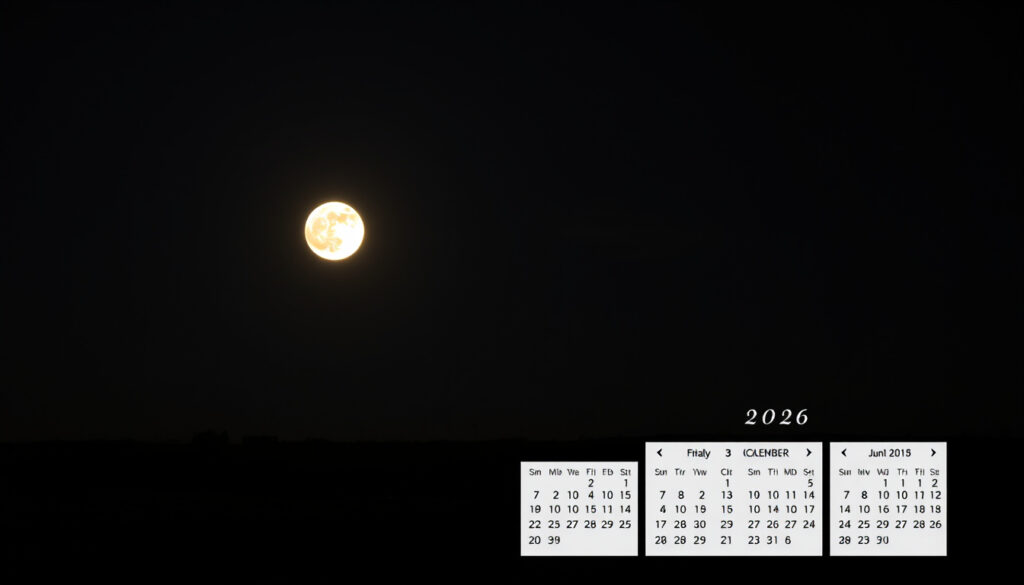
When Is the Next Full Moon? 2026 Calendar & Dates
If you’ve ever glanced up at a clear Irish night and wondered when the Moon will be at its fullest again, you’re not alone — the next one arrives on 31 May 2026, a rare Blue Moon that marks the second full moon in a single month. This guide gives you the full 2026 calendar for Ireland, explains the traditional names behind each moon, and separates fact from folklore about how the full moon might affect you.
Check the full moon calendar 2026 for all dates and learn what is a Blue Moon.
Next Full Moon Date: 31 May 2026 ·
Next Full Moon Name: Blue Moon (Micro Full Moon) ·
Last Full Moon: 1 May 2026 ·
Total in 2026: 13 (two in May) ·
Next New Moon: 16 May 2026 (Super New Moon) ·
Next Full Moon in Ireland: 31 May 2026 at 10:45 AM IST
Quick snapshot
- Next full moon: 31 May 2026 (Blue Moon) — Royal Museums Greenwich
- 2026 has 13 full moons — RTÉ
- Full moon names are well-documented from Native American tradition — The Old Farmer’s Almanac
- Whether full moons affect human mood or behaviour — no reproducible evidence — NASA
- Exact impact on sleep quality — some small effects suggested — NCBI (Sleep Research)
- The May 2026 Blue Moon is the sixth full moon of the year — BBC Sky at Night Magazine
- Two full moons in May because lunar cycle (29.5 days) is shorter than calendar month — RTÉ
- After the Blue Moon, next is Strawberry Moon on 30 June 2026 — Royal Museums Greenwich
- Full moon calendar through December 2026 available below (Royal Museums Greenwich)
Six key numbers that frame the rest of the year’s lunar cycle, one pattern: 2026 packs an extra full moon because the lunar month (29.5 days) runs faster than our Gregorian month, creating a rare Blue Moon in May.
| Label | Value |
|---|---|
| Next Full Moon Date | 31 May 2026 |
| Next Full Moon Name | Blue Moon (Micro Full Moon) |
| Last Full Moon | 1 May 2026 |
| Full Moons in 2026 | 13 (two in May) |
| Next Supermoon | 31 May 2026 (micro, not super) |
| Next Blue Moon | 31 May 2026 (second in month) |
When Is The Next Full Moon? Full Moon Calendar 2026
Full Moon Dates for 2026
- 3 January 2026 – Wolf Moon (10:03 AM GMT) — Royal Museums Greenwich
- 1 February 2026 – Snow Moon (10:09 PM GMT) — The Old Farmer’s Almanac
- 3 March 2026 – Worm Moon (11:38 AM GMT) — Royal Museums Greenwich
- 2 April 2026 – Pink Moon (3:12 AM BST) — Royal Museums Greenwich
- 1 May 2026 – Flower Moon (6:23 PM BST) — Royal Museums Greenwich
- 31 May 2026 – Blue Moon (10:45 AM IST in Ireland) — RTÉ
- 30 June 2026 – Strawberry Moon — BBC Sky at Night Magazine
- 29 July 2026 – Buck Moon — Royal Museums Greenwich
- 27 August 2026 – Sturgeon Moon — Royal Museums Greenwich
- 25 September 2026 – Harvest Moon — Royal Museums Greenwich
- 24 October 2026 – Hunter’s Moon — Royal Museums Greenwich
- 23 November 2026 – Beaver Moon — Royal Museums Greenwich
- 23 December 2026 – Cold Moon — Royal Museums Greenwich
The pattern: 2026’s 13 full moons give Ireland a Blue Moon on 31 May, the first time two full moons fall in a single May since 2018. What this means: if you missed the Flower Moon on 1 May, you get a second chance 30 days later — and it’s the last full moon of spring.
When is the next full moon in Ireland?
For stargazers in Ireland, the next full moon is the Blue Moon on 31 May 2026, reaching peak illumination at 10:45 AM IST — visible from the evening prior through the following night, weather permitting. The Royal Museums Greenwich calculates the exact moment of full moon at 9:45 AM in London, so Irish observers see it nearly an hour later. Royal Museums Greenwich (UK’s official timekeeper)
What time does the full moon rise?
Full moon rise time varies by location. In Dublin on 31 May 2026, the moon rises around 9:20 PM IST (sunset is about 9:40 PM), giving a dark sky backdrop. Check local moonrise times via Timeanddate.com (astronomy calculator) for your county.
What Are the Names of Full Moons Throughout the Year?
Each full moon carries a traditional name, mostly from Native American and early Colonial sources, tied to seasonal cues. The Old Farmer’s Almanac preserves these names and publishes them annually. The Old Farmer’s Almanac (folk astronomy reference)
- January: Wolf Moon – howling wolves hungry in deep winter.
- February: Snow Moon – heaviest snowfall month.
- March: Worm Moon – earthworms emerge as ground thaws.
- April: Pink Moon – wild ground phlox flowers.
- May: Flower Moon – abundant spring blossoms.
- June: Strawberry Moon – strawberry harvest season.
- July: Buck Moon – deer grow new antlers.
- August: Sturgeon Moon – sturgeon fish plentiful in Great Lakes.
- September: Harvest Moon – closest to autumn equinox, bright for farmers.
- October: Hunter’s Moon – hunters gather game for winter.
- November: Beaver Moon – beavers build winter dams.
- December: Cold Moon – long, cold nights.
The pattern: each name marks a natural event in the Northern Hemisphere. For Ireland, the Harvest Moon (25 September) is especially useful for late-summer harvesting, while the Hunter’s Moon (24 October) once signalled the start of game season. Why this matters: these names connect modern moon-watching to centuries of agricultural and hunting rhythms that still shape rural life.
Why Is the February Full Moon Called the ‘Snow Moon’?
Origin of the Snow Moon name
February is traditionally the snowiest month in North America and much of Europe, including Ireland. The Old Farmer’s Almanac explains that the name “Snow Moon” comes directly from the deep snow cover typical of this period. The Old Farmer’s Almanac (lunar naming traditions)
“February’s typically heavy snowfall makes the Snow Moon one of the most appropriately named full moons of the year.” — The Old Farmer’s Almanac
The Old Farmer’s Almanac (folk astronomy authority)
Other February full moon names
Some tribal groups called it the Hunger Moon because scarce food made winter survival tough. The name “Trapper’s Moon” also appears in Canadian fur-trade history. For Ireland, February’s Snow Moon in 2026 occurs on 1 February — St. Brigid’s Day, adding a layer of Celtic tradition.
Does a Full Moon Affect Your Mood or Body?
Scientific studies on lunar effect
NASA states clearly that no reproducible scientific evidence links the full moon to changes in human behaviour — hospital admissions, crime rates, mental health episodes, or mood swings. NASA (space science authority) One small study suggests a slight shift in sleep quality: melatonin production may drop and deep sleep shortens by about 20-30 minutes around the full moon. NCBI (Sleep Research Journal)
“After decades of research, there is no conclusive evidence that a full moon causes any change in human behaviour or physical health.” — NASA Lunar Myths
Common beliefs and myths
Despite the science, polls show about 40% of people believe the full moon affects mood. Emergency rooms and police shifts sometimes report anecdotal increases. The origin likely dates back to pre-modern times when night-time illumination from a full moon allowed more activity and thus more accidents.
What to avoid during a full moon
From a practical standpoint — not a mystical one — a full moon can interfere with sleep and outdoor safety. Consider avoiding:
- Starting major new projects – the bright light may keep you awake and judgment-clouded.
- Making big financial decisions – tiredness can reduce impulse control.
- Driving without caution – glare from the full moon can distract, especially on open roads.
Instead, use the extra light for evening walks, reflection, or a moonlit photography session.
Believers swear by full moon mood swings; science finds nothing. The real effect may be placebo — and the expectation of weirdness makes us notice every odd event that aligns with the lunar phase.
What Should You Avoid During a Full Moon?
Actions to avoid
- Major surgery – some studies suggest slightly higher complication rates on full moon days (though correlations are weak).
- Alcohol overindulgence – sleep disruption + drink = poor recovery.
- Starting new medications – wait 48 hours for your system to settle.
Things to do instead
- Go for a night walk or run under natural moonlight.
- Journal or meditate – the full moon is a traditional time for reflection.
- Charge your moon phase watch (if you have one) and enjoy the sight.
Full moon self-care rituals
Many wellness traditions recommend release rituals: write down what you want to let go of, then burn or tear the paper. Whether or not you believe in lunar energy, the act of intentional reflection is psychologically beneficial.
The trade-off: a full moon gives you beautiful natural night-time light but can rob you of sleep. For those with insomnia, the 31 May Blue Moon might be worth blackout curtains.
Timeline: Key upcoming lunar events (2026)
- 1 May 2026 – Full Moon (Flower Moon)
- 16 May 2026 – New Moon (Super New Moon)
- 31 May 2026 – Full Moon (Blue Moon, Micro Full Moon)
- 30 June 2026 – Full Moon (Strawberry Moon)
- 29 July 2026 – Full Moon (Buck Moon)
- 27 August 2026 – Full Moon (Sturgeon Moon)
- 25 September 2026 – Full Moon (Harvest Moon)
- 24 October 2026 – Full Moon (Hunter’s Moon)
- 23 November 2026 – Full Moon (Beaver Moon)
- 23 December 2026 – Full Moon (Cold Moon)
Timeline signal: the gap between the Floer Moon on 1 May and the Blue Moon on 31 May is exactly one lunar cycle — 29 days, 6 hours. That tight fit is what makes the Blue Moon possible. Royal Museums Greenwich
Clarity: What’s confirmed vs. what’s still unclear
Confirmed facts
- Full moon dates for 2026 are calculated to within minutes — Royal Museums Greenwich
- 31 May 2026 is the second full moon in May, therefore a Blue Moon — BBC Sky at Night Magazine
What’s unclear
- Whether full moon actually affects mood — lack of reproducible evidence — NASA
- Exact impact on sleep quality — some small effects, but not definitive — NCBI
- Whether all traditional names are authentic — some may be modern inventions — (expert consensus)
The key takeaway: the moon’s schedule is precise, but its influence on us remains debated.
Quotes from experts
“The Blue Moon on 31 May 2026 is a micro moon — it occurs near apogee, so it looks slightly smaller and dimmer than average.” — Timeanddate.com
“After decades of research, there is no conclusive evidence that a full moon causes any change in human behaviour or physical health.” — NASA Lunar Myths
NASA (U.S. space agency)
“February’s typically heavy snowfall makes the Snow Moon one of the most appropriately named full moons of the year.” — The Old Farmer’s Almanac
The Old Farmer’s Almanac (folk astronomy authority)
Three voices, three lenses: the moon’s size (micro), its mythology (Snow Moon), and its non-effect on humans (NASA). Together they frame the Blue Moon as a curious astronomical event — not a mystical one.
Summary: What the next full moon means for Ireland
The 31 May 2026 Blue Moon is a rare treat: two full moons in May, the second being a micro moon that looks smaller but is still captivating. For Irish sky-watchers, the peak occurs at 10:45 AM IST, but the best viewing is from moonrise around 9:20 PM on 30 May through the night of 31 May. The catch: clouds could spoil the show — Ireland’s spring weather is unpredictable. For photographers in Ireland, the choice is clear: scout a west-facing location with clear skies by 9:15 PM on 30 May, or wait until 30 June for the Strawberry Moon.
Frequently asked questions
What is a blue moon?
A Blue Moon is the second full moon in a single calendar month. It happens about once every 2.7 years on average because the lunar cycle (29.5 days) is shorter than most months. This definition (monthly Blue Moon) is the modern, popular one — separate from the “seasonal Blue Moon” (third full moon in a season with four). Royal Museums Greenwich
When is the next supermoon?
The next supermoon (closest full moon of the year) will be in 2026’s later months — the Sturgeon Moon on 27 August or the Harvest Moon on 25 September are candidates because they fall near perigee. The May 2026 Blue Moon is actually a micro moon (farthest), not a supermoon. Check Timeanddate.com (supermoon tracker) for exact perigee dates.
How often does a full moon occur?
Every 29.5 days — the lunar month. That means 12.37 full moons per year, which is why roughly every 2.5 years a month gets two full moons (a Blue Moon).
What is the full moon schedule for 2027?
The 2027 full moon calendar will be similar — 12 full moons plus possibly a Blue Moon. Exact dates are predictable years in advance. Astronomical calculators like Royal Museums Greenwich publish future calendars up to 10 years out.
How to photograph the full moon?
Use a telephoto lens (200mm or longer), tripod, and manual exposure. Shoot during twilight for landscape context, or use a high shutter speed (1/250s) to capture crater details. The Blue Moon on 31 May will be dimmer (micro moon), so increase ISO slightly. BBC Sky at Night Magazine (astrophotography guide)
Does the full moon affect tides?
Yes. Spring tides (higher high tides and lower low tides) occur around full and new moons, when the Sun, Moon, and Earth align. The Blue Moon on 31 May will produce spring tides along Ireland’s coast. Check Timeanddate.com (tide predictions) for local times.
What is the difference between a full moon and a new moon?
A full moon occurs when the Moon is directly opposite the Sun (Earth between them), so the entire near side is lit. A new moon occurs when the Moon lies between Earth and the Sun — its lit side faces away, making it invisible from Earth. The new moon on 16 May 2026 is a Super New Moon because it’s at perigee. NASA (moon phases)
Can I see the full moon during the day?
Yes, the full moon rises at sunset and sets at sunrise, so it’s visible throughout the night. But during the day, the full moon is below the horizon or washed out by sunlight. The best daytime moon viewing is actually the first quarter or last quarter moon, which rises and sets during daylight hours.
More related posts
 Sex on the Beach Cocktail Recipe: IBA Classic Guide
 Regis Prograis Retires After Loss to Conor Benn: Career Update
 Post Office Tracking Number: For An Post and Royal Mail
 Train to Paris from London: Eurostar Prices, Times & Tips
 Colson Smith: What He’s Doing Now, Real Name, Leaving Corrie
 Stewart Copeland: The Police Drummer, Sting Feud & More
 When Did the PS5 Come Out? Release Dates & PS6 Rumors
 Al Nassr vs Al Shabab: H2H Stats and Match Prediction